

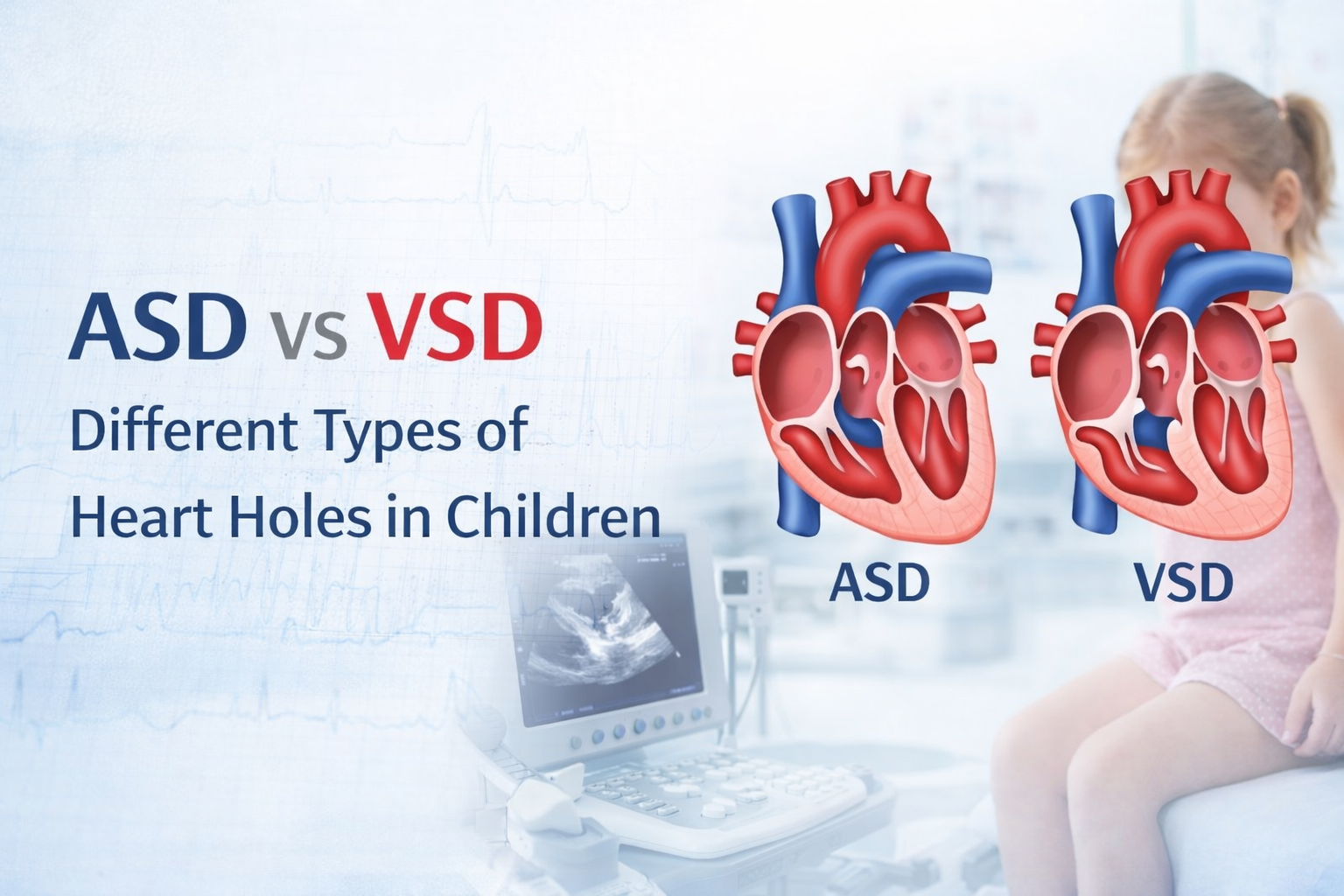
Hearing that your child has a “hole in the heart” can be frightening. However, not all heart holes are the same. The two most common types are Atrial Septal Defect (ASD) and Ventricular Septal Defect (VSD). Understanding the difference between them helps parents make informed decisions about care and treatment.
At Child Heart Health, under the expert care of Dr. Nidhi Rawal, families receive advanced and compassionate Heart Hole in Children treatment tailored to each child’s specific condition.
What Is a Heart Hole in Children?
A heart hole refers to an abnormal opening in the septum—the wall that separates the chambers of the heart. This opening allows oxygen-rich and oxygen-poor blood to mix, which may affect how efficiently the heart pumps blood to the body.
The type of septal defect depends on where the hole is located.
What Is ASD (Atrial Septal Defect)?
An Atrial Septal Defect (ASD) is a hole in the wall between the two upper chambers of the heart (atria).
Key Features of ASD:
- Located between upper heart chambers
- Often mild in early childhood
- May not show symptoms for years
- Can sometimes close on its own if small
Symptoms of ASD:
- Frequent respiratory infections
- Shortness of breath during activity
- Fatigue
- Poor growth in some children
Small ASDs may only require monitoring, while larger defects may need catheter-based closure or surgery.
What Is VSD (Ventricular Septal Defect)?
A Ventricular Septal Defect (VSD) is a hole between the two lower chambers (ventricles) of the heart. This is one of the most common congenital heart defects in children.
Key Features of VSD:
- Located between lower heart chambers
- Can range from small to large
- More likely to cause symptoms in infancy
Symptoms of VSD:
- Rapid breathing
- Difficulty feeding
- Excessive sweating
- Poor weight gain
- Frequent lung infections
Large VSDs often require early medical intervention to prevent complications.
ASD vs VSD: What’s the Difference?
| Feature | ASD | VSD |
| Location | Upper chambers (atria) | Lower chambers (ventricles) |
| Severity | Often mild | Can be more serious |
| Symptoms | May appear later | Often appear in infancy |
| Treatment | Monitoring or catheter closure | Monitoring, medication, or surgery |
The severity and treatment plan depend on the size of the defect and how it affects the child’s heart function.
Diagnosis of Heart Holes in Children
Early diagnosis is crucial for effective Heart Hole in Children treatment. At Child Heart Health, advanced diagnostic tools are used, including:
- 2D/3D Echocardiography
- Electrocardiogram (ECG)
- Chest X-ray
- Detailed clinical evaluation
Accurate imaging helps determine whether the defect is small and manageable or requires intervention.
Treatment Options for ASD and VSD
Treatment depends on several factors including defect size, symptoms, and the child’s age.
1. Observation
Small ASDs and VSDs may close naturally as the child grows. Regular monitoring ensures the heart remains healthy.
2. Medications
Medications may be prescribed to manage symptoms like fluid buildup or heart strain.
3. Catheter-Based Closure
Many ASDs and some VSDs can be closed using minimally invasive catheter procedures, avoiding major surgery.
4. Surgical Repair
Larger or complex defects may require open-heart surgery. Modern surgical techniques have made these procedures highly safe and successful.
Consulting an experienced pediatric cardiologist in Gurgaon ensures timely and appropriate treatment decisions.
Expert Care at Child Heart Health
Dr. Nidhi Rawal is a trusted pediatric cardiologist in Gurgaon, specializing in diagnosing and managing congenital heart defects including ASD and VSD. Her approach focuses on:
- Early and precise diagnosis
- Personalized treatment planning
- Minimally invasive options when possible
- Long-term follow-up for optimal heart health
Families seeking expert Heart Hole in Children treatment benefit from comprehensive care designed to help children grow and thrive without limitations.
Can Children with ASD or VSD Live Normal Lives?
Yes. With early detection and proper management, most children with ASD or VSD lead completely normal, active lives. Advances in pediatric cardiology have significantly improved long-term outcomes, allowing children to participate in school, sports, and daily activities safely.
If your child has been diagnosed with a heart hole or is showing symptoms, early consultation can make all the difference. At Child Heart Health, Dr. Nidhi Rawal provides expert evaluation and compassionate care to ensure the best possible future for your child’s heart.